
Deprecated: Creation of dynamic property CSF_Metabox::$post_formats is deprecated in /home/u451720432/domains/venture-suite.com/public_html/wp-content/plugins/swp-portfolio/lib/codestar-framework/classes/metabox.class.php on line 44

Deprecated: Creation of dynamic property CSF_Metabox::$page_templates is deprecated in /home/u451720432/domains/venture-suite.com/public_html/wp-content/plugins/swp-portfolio/lib/codestar-framework/classes/metabox.class.php on line 45
Articles – Venture Suite

Home >

5 elements for your financial deck you can’t afford to miss – Venture Suite

The financial slide on your pitch deck conveys the most crucial information about your business. Often, it becomes the deciding factor in whether you are going to get funded or not. These slides must clearly and concisely describe a company’s financial situation while estimating its future revenue potential. The key to getting your financial deck effectively accepted is to translate your numbers into a meaningful and understandable presentation that is harmonious with the investor’s psyche. According to Venture Suite’s research, investors look for certain key metrics to be displayed in certain ways.

On the contrary, there is no hard and fast rule that investors will like a certain display of key metrics. This sentence might sound quite ambiguous. It is so mainly because financial data is always influenced by the startup’s maturity. For instance, a startup seeking angel investment that has no clients won’t have the information necessary to make financial projections. On the other hand, startups that are raising larger rounds can show investors financial information that dates back years. Simply put, a financial deck is a representation of your finances influenced by your operational history, size, expertise, and related variables.

Present Yourself Succinctly

Understand the importance of financial data in your pitch deck. Your data should represent what you do and should reflect your ethics on practical business grounds. So let’s focus on the basics of checking to interpret your data.

As a business, you should represent:

  • Income & Expenses
  • KPIs
  • Profitability
  • Existing Funding
  • Market Sizing

Financial data always depends on the startup’s maturity. A startup seeking angel investment, for instance, won’t have the information necessary to make financial projections if it has no customers. On the other hand, startups that are raising more money have years’ worth of financial information to share with investors.

Income and Expenses

Investors are most concerned with income (and a company’s potential for future income) when assessing financial metrics.
Investors desire huge revenue growth from the businesses they fund. Higher revenues for startups translate into higher valuations, which eventually translate into higher investor returns.

The three prime elements of income are:

  1. Revenue: a general overview of all income earned thus far.
  2. An income statement is a proper financial statement that lists income and expenses.
  3. Sales Forecast: An estimate of future sales revenue.

Business is about generating a profit and scaling in the long run. Profit has a price, so to more accurately assess their investment, investors want to know how much a startup’s operational costs are.

Investors are going to question you about certain elements of expenses, and the questions might be:

  • How much does the product’s manufacturing cost (cost of goods sold) total?
  • How much does the startup spend on labour?
  • How much do administrative and general overhead costs cost?
  • Spending plans for sales, marketing, and advertising
  • What about anything that is sector-specific, like credentials or licences?

To give investors a general overview of the company’s financial health and profitability, income and expenses are frequently combined on the same slide.

Business KPIs

Every business model needs to develop its own specific KPIs (Key Performance Indicators). These KPIs ensure the path to business success.

Any business metric that helps a founder to ensure scalability and chart a growth trajectory is an essential KPI to be presented. Investors not only look for quality KPIs but also for the dedication of a founder towards the growth trajectory of a business. In general, the KPIs can be:

  • Customer Growth: The rate, typically displayed monthly or annually, at which a startup acquires new customers over time.
  • Customer Lifetime Value (CLV) is a forecast of how much money a customer will spend with a company throughout their relationship, as measured by average turnover.
  • Churn Rate: The percentage of customers who discontinue doing business with a startup, typically displayed monthly or annually.
Profitability

Investors may not be interested in immediate profitability, but they are interested in revenue potential, which, as we previously mentioned, ultimately determines a company’s future value.
A company with $100 million in revenue and a 10x valuation when it goes public will have an equity value of $1 billion. A shareholder may choose to sell their shares and profit significantly from their investment.

To justify your profitability, certain metrics need to be presented in front of investors to make a solid mark. They are:

  • Break-even rate: The point at which a company’s income equals its costs.
  • EBITDA / Gross Profit: Earnings Before Interest, Taxes, Depreciation, and Amortisation.
  • Gross Margin: Calculated as the gross profit multiplied by the revenue.
Existing funding

A startup’s likelihood of receiving funding can be increased by social proof in any form. Providing evidence of prior funding can be done for later-stage startups (Series-A and above).

The capitalization table is a more in-depth version of the previous funding slide. A complex breakdown of their shareholder equity is frequently displayed by startups using this method. Common equity shares, preferred equity shares, warrants, convertible equity, and more are all included in the cap table.

It aids investors in comprehending current ownership percentages and offers social proof that other investors are optimistic about the prospects of a specific startup.

Market Sizing

Every pitch deck must include a slide for market size, which is typically a stand-alone slide. Market sizing is an opportunity for a separate explanation. However, it is a very important aspect when it comes to investors considering funding your startup. As a founder, if you can convince the investors that you are aware of the market size and your brand positioning, then you are halfway to your funding.

Market sizing is the term used to describe the volume of demand for a startup’s goods or services. Additionally, it goes by the names TAM, SAM, and SOM.

  • The total Available Market (TAM) refers to the total market demand for a wide range of goods or services. The largest of the three numbers is this one.
  • The segment of the TAM that a company’s particular products and services are targeting is known as the SAM (Serviceable Available Market). A geographical region or a smaller sector (TAM) within the larger sector could be this. This is the second largest number.
  • The portion of the SAM known as the SOM (Serviceable Obtainable Market) is what a startup can reasonably expect to take over in the coming years. In the upcoming years, a startup can expect to take over the portion of the SAM known as the SOM (Serviceable Obtainable Market). This is the smallest number of the three.

Final Words

Your financial presentation is the soul of your pitch deck. The more concise, clear, and professional you appear on this front, the better impression you will have in the eyes of investors.

Similarly, you have to be intelligent about your presentation of facts and not confuse your investors by providing too much information. Consciousness is the key to cracking your presentation. The overall idea is to provide a clear, numerical picture of your business in front of the investors for them to decode in their way. Once they are thorough and satisfied, they will be interested in investing in your business. The elements mentioned in this blog hold much importance and, when done right, can be enough for your financial presentations.

Overall, follow the tips for amplifying your presentation and nailing your pitch in the very first instance. Remember, providing clarity to investors is the key to success and getting funded. Be clear, professional and thorough to succeed in your coming pitches.


Read More

Attention Founders! Avoid these mistakes while defining your KPIs.

Key performance indicators offer goals for teams to strive for, benchmarks to measure advancement, and insights that aid individuals throughout the organization in making better decisions. Key performance indicators support the strategic advancement of every department within the company, from marketing and sales to finance and human resources.

It is essential to develop certain yardsticks to measure growth over differences between standard and actual work from time to time in the organization. Well-described KPIs can help you achieve growth in numerous ways and can help you scale your business while logically implementing decisions based on factors and situation-based problems.

Leaders at mature startups and established businesses both ask, “How do we define our organization’s KPIs?”
This fundamental question, despite its critical importance, is frequently asked without first addressing its two underlying suppositions:

  1. The organization has a well-defined goal in place, and each individual has their own clear goal in mind.
  2. The team in charge of defining KPIs has the same clarity in their work.
The end goal with KPIs

Often, it happens that organizational policies take KPIs for granted. Many times they don’t align with the actual indicators in mind. This should be gravely avoided. The early assumptions that we had indicated that productivity will depend on the clarity of objectives and subsequent work upon them. Here are the most common goals that are fulfilled by KPIs.

Alignment of work and teams: KPIs help you measure the success of projects, performance, or employee satisfaction while reaching organizational goals in the same direction.

Reality Check: These indicators provide you with a reality check on your organization. They tell you what is going on with the overall health of your organization. These take inputs from working risk factors and financial indicators.

Adjustments: KPIs enable you to make your decisions practically. Hence, you will be more inclined towards reality-based decisions rather than thought-based ones. KPIs enable you to adjust whenever required.

Authority-Responsibility bridge: When KPIs are maintained and measured properly, the bridge between authority and responsibility is maintained at a healthy level and accountability comes in automatically.

These four are the end goals with KPIs in every organization. Now you may have separate goals, but overall, these 4 elements are the core offerings that a well-structured KPI provides.

What should you do?

Find your static

We define “static” as the consistency and dependability of the measured results. By extension, this means that results at different times can be accurately compared.

A fixed statistic from which you might want to develop a key performance indicator would be, for instance, the finding that in January and February, 1 out of every 100 individuals who began a trial of your product turned into a customer. So, this will help you formulate many observations that will lead to different discoveries regarding your business and business framework developments.

Ensure the ability to forecast

Although you don’t need to use artificial intelligence to the fullest extent, KPIs must at least somewhat assist you in making predictions. Your figures must be understandable to the extent of

Assume that once you reach a certain Net Promoter Score, the period from trial to customer appears to be significantly shorter. Seeing this correlation may allow you to forecast: increased customer success = decreased time between trial-to-customer.

Depending on what organizational objectives you’ve decided on, building a KPI around this forecast may be worth your time.

The mistakes to avoid

In business processes, mistakes happen. Even the most renowned businesses have trouble avoiding these simple yet critical mistakes. They can occur at various stages of a company’s development, such as when new team leaders are hired, when new goals are set, or when out-of-date KPIs are kept up while an industry goes through a rapid period of change. The most common KPI mistakes are:

  • Reliance on intuition: This occurs usually because founders assume that they know their business and, hence, they will understand what is fundamentally good for their trade. While this may work from time to time, it is not something the founder should trust upon. This can arise from the overconfidence effect and can also ruin many great opportunities. Hence, follow data rather than guts.
  • Blindly adopting commonly held best practices rather than creating your own: Many founders adopt this practice due to FOMO. It can also be caused by a lack of confidence in one’s framework and trying to copy competitors’ moves to beat them in their own game.
  • Bias toward the most recent information learned: Bias happens when you strongly believe something without thinking about in-depth matters. This should be strongly avoided as the founder should go after the results fetched from the data, rather than with one’s belief systems.
  • Confusing lagging indicators (the easy-to-measure output) with leading indicators (the difficult-to-measure input).
Final Words

KPIs are the spinal fluid of the business structure. As a founder, you should make your end goal crystal clear when fixing KPIs.

Operating based on your experience can be good when making certain decisions. But while making practical business decisions, you should always go for your fulfilled KPIs and supporting data.

Hence, keeping the end goal in mind and communicating the same to every unit of your organization will help you to gain productivity and efficiency, and your KPIs will be in place to ensure business success.

Read More

How many different versions of a pitch deck do you optimally need?

A startup’s origin story is crucial. It includes the issues they address, the recommendations made, the victories achieved, the objectives they have for the future, and the plans they have to achieve those objectives.

It’s the real reason we say that stories are significant.

However, there are countless ways to convey the story of a startup. Founders are urged to have several iterations of their pitch deck, in particular.

But the majority of entrepreneurs find themselves asking two queries:

  1. How many revisions are necessary?
  2. How do these variations appear?

A quick Google search will turn up a variety of investors’, consultants’, and business people’s perspectives. However, these viewpoints frequently conflict with one another, making it challenging for the typical founder to obtain specific and reliable responses to crucial questions.

We set out on a quest for more clarity in our effort to assist founders in building pitch decks that secure funding. We gathered investor opinions and quantitatively analyzed them in search of trustworthy solutions.

Online, there are 21 investor opinions on the need for different pitch decks.

Discussing methodology; we started by searching the internet for articles about different pitch decks. We checked the credentials of the authors of the sources we discovered, eliminated consulting firm opinions, and only kept investor opinions.

We gathered a total of 21 resources from venture capitalists and investment companies. Posts on blogs, articles, and books were used as resources.

We discovered during our research that the majority of investors referred to different pitch deck versions by different names.

We standardized their viewpoints based on mutual function and common language to prevent misunderstanding.

Let’s get to the data.

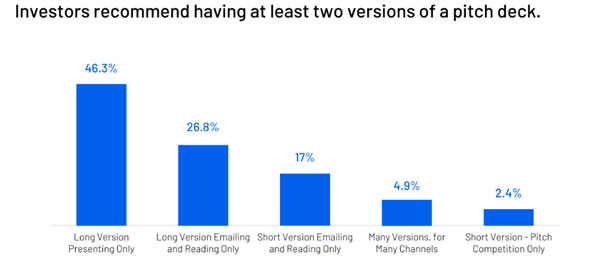
Investors recommended a total of five different iterations, but only two or three were crucial.

Investors suggested the following five categories for pitch decks:

  • The version in Length: Presenting Only
  • Emailing and Reading Only, Long Version
  • Only Emailing and Reading, in Brief
  • Summary: Pitch Competition Only
  • Multiple Versions, Multiple Channels

According to our quick research, all of the investors and investment firms concur that founders should have two different pitch decks: a “long version” and a “short version.”

So, how many versions of a pitch deck do investors recommend?

At least two, but the three most popular advices were as follows:

  • Long Version for Presenting Only
  • An extended version for reading and emailing only
  • A condensed version for reading and emailing only

But how do they appear? Let’s examine our findings in more detail to learn the true sentiment of investors.

(46%) Long Version for Presenting Only

A lengthy version of the pitch deck that is only for presentations is advised by nearly half (46%) of investors.
Investors claim that this Long Version for Presenting Only contains 10 to 15 slides and is designed to be delivered in no more than 60 minutes.

This version is known as a “presentation backdrop” by most investors. They advise that this version contain crucial information like data, charts, and product demos and be more visually appealing and less text-heavy because it serves as a visual aid for investors. Investors advise replacing text-heavy slides with high-level speaking points.

Investors are of the opinion that an audience may become distracted by excessive text if a speaker is present.

A well-known investor and consultant for us says:

You should have two copies of the pitch deck: one to use when delivering the pitch in person and another with more information to send to people who will read it independently. When giving a presentation in person, you only want to cover the most important points because you want the audience to be paying attention to you and not straining to read the minute details on your slides.

Long Version for Reading and Emailing Only (27%)

What many investors referred to as the “standalone version,” or what we’re calling the Long Version for Emailing and Reading Only, is secondary to the Long Version for Presenting Only.
With 26.83% of investors recommending it, this pitch deck version is the second most frequently suggested by investors.

Individual investors are intended to receive and read standalone decks via email. Stakeholders or investors will also distribute it internally for further review. As a result, this version is lengthier and a little more verbose (while still having excellent design, of course).
The appendix and expanded text on each slide contain the majority of the extra information.

Given how many decks are sent to investors each day, this also serves as a way to address any questions that might come up.

They prefer to compile all the necessary information at once so they can swiftly reject opportunities that don’t align with their goals.

(17%) Abbreviated Version for Reading and Emailing

Investors frequently refer to a different, relatively shorter version of a standalone deck as the “teaser deck.”
The “short version” is what we refer to it as when emailing and only reading.

This version serves as a briefing document to inform investors of what to expect during the pitch, just as its name implies.

Typically, teaser pitch decks are a succinct business overview that includes the following:

  • Your identity
  • Your actions
  • What makes you special
  • What makes the market opportunity so large?

One venture capitalist from US recommends that teaser pitch decks should be around 8-12 slides.

According to them:
Regardless of whether you are fund-raising or not, you should always have a “teaser deck” ready to send. The reader should be able to scan your materials quickly and visually and gain an understanding of who you are, what you do, why you’re truly unique, and why the market opportunity is enormous.

(5%) Many Versions, for Many Channels

After discussing the top three most used variations, let’s examine the remaining ones.
Only two of the investors in our study agreed that a founder can never have too many iterations of the pitch deck. 5% of investors, according to our quick research, advise having virtually unlimited versions, and for good reasons as well.

This suggests that there are different pitch deck versions depending on the audience and the intended method of consumption. While some pitch decks are designed to be independently studied by investors, others are used as a “backdrop” during presentations.

However, investors also advise developing pitch decks that are specifically targeted at investors.

(2%) Pitch Competition Only, Short Version

The pitch competition deck is an additional version that might be useful.

Only 2% of investors (one out of 21) in our study recommended using this pitch deck, making it the least popular. That does not, however, imply that it is not required.

During pitch competitions, competition pitch decks—which typically have 8–10 slides—are presented live on stage. Companies typically have five minutes to publicly present in front of dozens of other startups.

The fundamentals should be covered in both teaser decks and pitch competition decks, including:

  • Your identity
  • Your actions
  • Why are you special
  • What makes the market opportunity so large?

However, pitch competition decks frequently have less text and more visuals because they are meant to be presented onstage or in a showy manner. Contrarily, teaser decks are intended to be read by investors, necessitating more copy and occasionally more slides.

Conclusion: Founders most likely won't be able to get by with just one pitch deck.

To address one of the most pressing queries founders have: How many pitch deck versions do I need to make? we gathered and analyzed investor opinion.
Here is a summary of what we learned:

  • Investors think founders should have two different versions of their pitch decks.
  • Most frequently suggested: According to our study’s investors, 46.34%, a complete presentation deck should be used as a visual aid during pitches.
  • Second most popular: 26.83% of investors think that when seeking funding, a full pitch deck should be sent via email.
  • A Short Version for Reading and Emailing Only came in third place, with 17% of investors recommending it.

Startup stories can and should be told in a variety of ways, with varying degrees of detail, and through a variety of media.

The good news is that you don’t have to go crazy making endless variations. Probably only two are necessary for startups. Maximally three.

Read More

Here’s How should startups present their first year’s finances effectively.

When discussing startup revenue projections, the word “realistic” is constantly brought up. Investors have stated time and time again that they prefer projections that are accurate, practical, and attainable. But it’s a mystery how to calculate a company’s first year’s revenue.

Depending on the business model and maturity of a startup, revenue projections vary. On the one hand, post-revenue startups can make projections based on historical data.
Pre-revenue startups sadly lack this convenience.

So, how should startups start out with their financial projections to suggest a realistic revenue trajectory over time?

We have gathered some of the methodologies and insights to comprehend how to project the first year revenue for a startup through our years of experience in startup fundraising.

Methodology

First, we combined and analyzed our financial data. We assisted startup owners in developing accurate financial projections for use by lenders, investors, and business plans. To maintain privacy between the parties, the entire data set was kept anonymous.

We examined 102 pitch decks in total from various funding rounds:

  • 16 startups seeking pre-seed capital
  • 68 startups seeking seed funding
  • There are 18 Series-A startups.

In addition to breaking down the data by round, we decided to divide each pitch deck according to the business model.

Here’s an overview of the data:

  • 39 B2B technology startups
  • 30 B2C tech companies
  • 17 D2C startup businesses
  • 16 Marketplace startups

Before we discuss the data and findings, it’s important to note that our current database does not have enough data to make any solid analysis of D2C and marketplace business models. As we further dissect this data into rounds, the data set will consequently get smaller. So as usual, we recommend a grain of salt with this one.

Now, to the data.

Overview

By Business Model

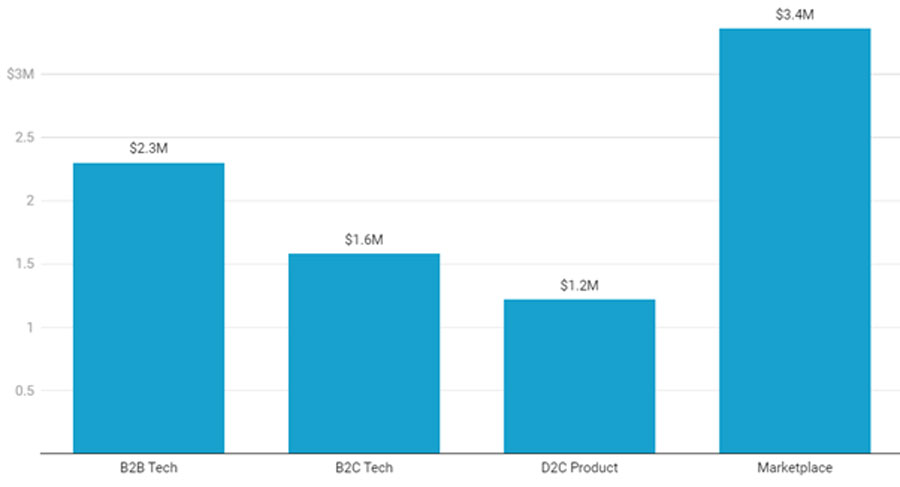
The projection of first-year revenue for startups with various business models is shown in the chart below. Different business models scale up and grow in different ways. Some businesses produce slow and steady growth, while others generate revenue more quickly.

It’s noteworthy that this data set includes startups from various funding rounds. Here, regardless of the stage of maturity each business is in (pre-revenue or post-revenue), we can see how each one scales. We will discuss this in-depth later.

Compared to their competitors, startups in the marketplace anticipate the highest levels of revenue. This is due to the fact that their platform will generate revenue from every transaction, leading to higher overall projections. We don’t have enough information about Marketplace startups to draw any firm conclusions, though.

B2B Tech, on the other hand, is projected to have the second-highest year-one revenue, at an average of $2.3M.

In comparison to other business models, B2B companies have the potential to generate more revenue in a single transaction, which explains why their projections are also so high.

By Round

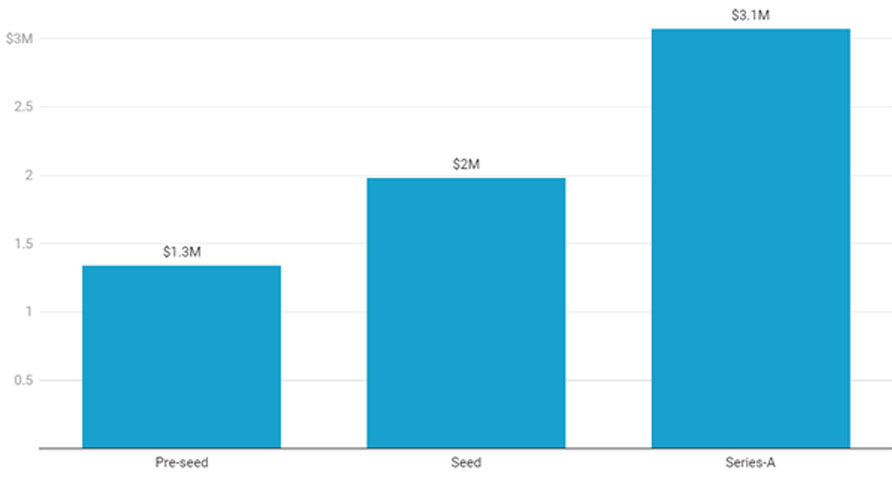
Let’s examine the revenue projections for startups at various stages of development.

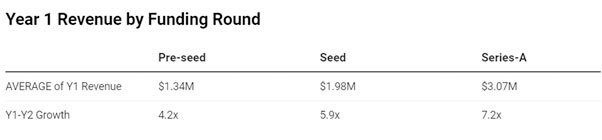
The graph below shows that pre-revenue startups’ projections are a little bit more conservative. However, it isn’t too conservative to make investors think that the opportunity isn’t profitable.

According to our data, seed round startups anticipate bringing in $2 million in revenue for the first year, compared to pre-seed startups’ $1.3 million. Since the majority of pre-revenue startups are still going through development and initial expansion, including R&D and hiring for key positions, this is still regarded as a significant sum of money.

Series-A startups, on the other hand, predict with confidence a $3.1M year-1 revenue because they have already gained some initial traction and other crucial metrics to make reasonable projections.

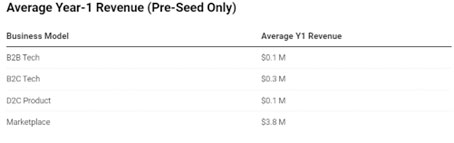
The table below shows that Pre-Seed businesses in the B2B and B2C tech categories have the lowest projected year-one revenues, at less than a million.

Even so, Marketplace startups project a startling $4M in their first year, despite the fact that they are pre-revenue startups. It is obvious that startups in the market make extremely optimistic financial projections.

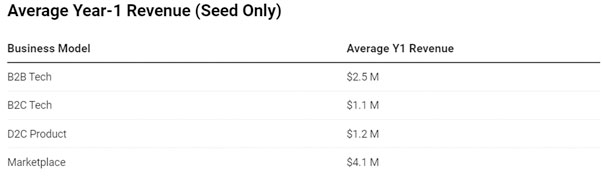
Millions of dollars in revenue are anticipated by slightly mature startups in the seed round. With $1.1M in year-one revenue, startups in the B2C Tech and D2C Products categories have the lowest financial projections.

B2B Tech, on the other hand, had slightly higher year-1 revenue, coming in at $2.5M. Since B2B startups typically generate higher revenue per client, we think this is a result of the nature of their business model.

In the meantime, Marketplace startups continue to project $4M in potential revenue, demonstrating their continued confidence in their ability to increase revenue within a year.

Our post-revenue startup data reveals a striking difference in revenue projections, with Marketplace startups only projecting $1.5M.

As they significantly lower their year-1 projection, this demonstrates that mature Marketplace startups are more influenced by experience and historical data. It is important to keep in mind, though, that the number of startups in our database (n=5) is relatively small.

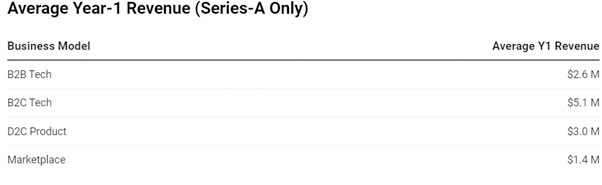
For Series-A startups, B2C Tech has the highest year-1 revenue projection. Despite having only five participants, they are assuming $5.1 million in revenue.
B2B Tech, with projected revenue of $2.8M, falls in the middle of the spectrum. The most startups in the Series-A round are from B2B Tech (n=9). From the seed round to Series A, there is a slight increase that is noticeable.

The projections of pre-seed and seed startups, also referred to as “pre-revenue startups,” are more conservative.

This is due to the lack of specific metrics—such as customer or revenue metrics, for instance—on which they can currently base their financial projections. Consequently, they would undoubtedly have a lower revenue projection than Series-A.

As they would have the necessary metrics at this stage, Series-A startups have an advantage over others when making projections.

From B2B Tech onward, it is clear that there are very high expectations for the first year of their startup.

Due to the frequently small teams at these startups, this is especially intriguing for B2C tech business models.

Although the sample sizes for the D2C product and marketplace were quite small for this study, their projections were still sufficiently high to warrant attention.

Out of all business models, B2C tech is expected to grow at the fastest rate. According to their revenue projection, this is exactly what happened.

Conclusion

Given the information they may or may not have, pre-revenue startups predict revenue more conservatively than post-revenue startups.

Overall, this study shows that, when compared to other business models, B2B Tech has the lowest and, arguably, most realistic year-one revenue.

A “realistic” first-year revenue forecast still depends on the startup’s funding round and business model. However, it’s critical to keep in mind that the projection for the first year should also dictate the projections for the following year.

We advise using a marker of 2x annually because it will demonstrate significant growth without appearing irrational to investors.

Read More

Google Fi is offering $100 to upgrade your 3G phone before it stops working

James McCann seasoned CEO, speaker, and advisor to early-stage businesses, today announced the publication of Startups & The Tech Revolution: The Essential Guide (available now). The book is published with ForbesBooks, the exclusive business book publishing imprint of Forbes Media.

Over the course of 20 years, James McCann had a C-suite view of the technology revolution and its impact on his own organizations. He knows from first-hand experience what happens when companies refuse to adapt. “This is a world that is not going to spoon feed you; it moves way too quickly for that,” he said. In Startups & The Tech Revolution, McCann explains that companies that are not prepared for the current technological paradigm and employees who are unwilling to retrain or upskill are exposed to unprecedented risk.

“A brand for a company is like a reputation for a person. You earn reputation by trying to do hard things well.” Jeff Bezos.

McCann’s focus is always on the future. He believes that where there is risk, there is also opportunity but, to see and take advantage of it, leaders and employees must be receptive to change. In addition to sharing lessons from his own experience, he cites various studies to shed light on expert predictions and offers a strategic approach to help startup companies thrive.

He leads readers to a solution that demands the adoption of a deeper entrepreneurial mindset and embraces the challenge to develop more adaptable and anticipatory playbooks and provides direction for those looking to invest in a startup business or launch their own. “By understanding the shift that is taking place, you will be able to make the most of these changes for yourself, your family, your company and your community,” he said.

Read More

What games updated for the Oculus Quest? Here’s every game being enhanced

James McCann seasoned CEO, speaker, and advisor to early-stage businesses, today announced the publication of Startups & The Tech Revolution: The Essential Guide (available now). The book is published with ForbesBooks, the exclusive business book publishing imprint of Forbes Media.

Over the course of 20 years, James McCann had a C-suite view of the technology revolution and its impact on his own organizations. He knows from first-hand experience what happens when companies refuse to adapt. “This is a world that is not going to spoon feed you; it moves way too quickly for that,” he said. In Startups & The Tech Revolution, McCann explains that companies that are not prepared for the current technological paradigm and employees who are unwilling to retrain or upskill are exposed to unprecedented risk.

“A brand for a company is like a reputation for a person. You earn reputation by trying to do hard things well.” Jeff Bezos.

McCann’s focus is always on the future. He believes that where there is risk, there is also opportunity but, to see and take advantage of it, leaders and employees must be receptive to change. In addition to sharing lessons from his own experience, he cites various studies to shed light on expert predictions and offers a strategic approach to help startup companies thrive.

He leads readers to a solution that demands the adoption of a deeper entrepreneurial mindset and embraces the challenge to develop more adaptable and anticipatory playbooks and provides direction for those looking to invest in a startup business or launch their own. “By understanding the shift that is taking place, you will be able to make the most of these changes for yourself, your family, your company and your community,” he said.

Read More